Screen Time Guidelines for Kids by Age: What AAP and WHO Say
Updated 2026-11-10 · By the Touch Grass editors
The WHO recommends no screen time for babies under 1, no sedentary screen time for 1-year-olds, and no more than 1 hour a day for ages 2–4, with less being better. For ages 5–17 it says to limit recreational screen time without giving a number. The AAP's 2026 policy drops hour limits and focuses on content, context, screen-free bedrooms and meals, and a family media plan.
If you've heard three different screen time rules from three different people, you're not imagining it. The guidance changed in 2026. The American Academy of Pediatrics (AAP) released a new policy that moves away from hour counts, while the World Health Organization (WHO) still gives specific limits for kids under 5.
Here's what each one actually says, linked to the source, and some practical swaps for each age. Every family's situation is different, and none of this is a test you pass or fail.
| Age | WHO says | AAP says (2026) |
|---|---|---|
| Under 1 | Screen time is not recommended | No hour limit. Infants under 18 months learn best from real-world interactions |
| 1 year | Sedentary screen time is not recommended | No hour limit. Focus on quality, context and conversation |
| 2 years | No more than 1 hour of sedentary screen time a day. Less is better | No hour limit. Watch and play alongside your child |
| 3–4 years | No more than 1 hour of sedentary screen time a day. Less is better | No hour limit. Screen-free bedrooms and mealtimes |
| 5–12 years | Limit sedentary time, particularly recreational screen time. No specific number | No hour limit. Family media plan, the 5 Cs, media-free spaces |
How much screen time should a child have by age?
Under the WHO's guidelines, babies under 1 should have no screen time, 1-year-olds no sedentary screen time, and 2- to 4-year-olds no more than one hour a day, with less being better. For kids 5 and up, the WHO says to limit recreational screen time but doesn't set a number.
The AAP no longer gives hour limits for any age. Its 2026 policy asks families to look at what kids watch, what screens replace, and how media fits the family's routines.
What does the WHO recommend for children under 5?
The WHO's 2019 guidelines for children under 5 set screen time limits alongside activity and sleep targets:
- Under 1 year: "Screen time is not recommended." Be physically active several times a day, and get 14–17 hours of sleep (0–3 months) or 12–16 hours (4–11 months), including naps.
- 1–2 years: sedentary screen time is not recommended for 1-year-olds. For 2-year-olds, no more than 1 hour, and less is better. At least 180 minutes of physical activity a day and 11–14 hours of sleep.
- 3–4 years: no more than 1 hour of sedentary screen time, and less is better. At least 180 minutes of activity, including at least 60 minutes of moderate-to-vigorous activity, and 10–13 hours of sleep.
"Sedentary screen time" means sitting and watching, like TV, videos or computer games.
What does the WHO recommend for kids 5 to 12?
For ages 5–17, the WHO's 2020 guidelines say children "should limit the amount of time spent being sedentary, particularly the amount of recreational screen time." They don't give an hour figure.
The same guidelines recommend an average of at least 60 minutes a day of moderate-to-vigorous physical activity across the week. Thinking about what to add, like outside time, can be easier than counting what to cut.
What does the AAP recommend in 2026?
The AAP's current guidance is its policy statement "Digital Ecosystems, Children, and Adolescents," published online January 20, 2026, in Pediatrics. It replaces the AAP's earlier guidance on media, and its family recommendations don't include hour limits.
For families, the AAP recommends:
- Create a Family Media Plan. The AAP has a free tool on HealthyChildren.org.
- Model healthy media habits with your own devices.
- Use the "5 Cs of Media Use."
- Set aside media-free spaces, such as the car, dinnertime or weekends.
The AAP's HealthyChildren.org explainer adds that bedrooms and mealtimes are good places to start screen-free zones, "especially an hour before bed." It also suggests you "watch and play alongside your kids."
What happened to the AAP's one-hour rule?
The one-hour rule came from the AAP's earlier guidance. A 2016 HealthyChildren.org article said pediatricians advised against TV and apps before 18 months, with video chat as the exception, and suggested capping electronic entertainment at 1 hour a day from 18 months to age 5.
The 2026 policy replaced that earlier guidance. HealthyChildren.org now urges families to "move beyond simple screen-time limits and focus on quality, context and conversation." The WHO's one-hour cap for ages 2–4 still stands.
What are the AAP's 5 Cs of media use?
The 5 Cs are a framework from the AAP's Center of Excellence on Social Media and Youth Mental Health. They are:
- Child: think about your individual kid.
- Content: what they're watching or playing.
- Calm: how media affects their ability to calm down and self-regulate.
- Crowding out: what screens take the place of, like sleep, play or time together.
- Communication: talking with your kid about media.
Does video chatting with grandparents count as screen time?
Video chat has been the classic exception. The AAP's 2016 guidance said that even babies and toddlers can video-chat with a distant grandparent or a deployed parent. Sitting with your little one and joining in helps it feel like a real conversation.
Screen-free swaps for babies and toddlers (0–2)
At this age, the easiest swaps are for the grown-ups' screens. Floor play and a few good toys go a long way.
- Play ideas without scrolling: Lovevery Play Kits are timed to your child's stage and come with a parent guide of activity ideas.
- Nursery sounds without a phone: the Hatch Baby is a sound machine and night light with time-to-rise cues, so your old phone doesn't have to sit in the crib room running a white-noise app.
Lovevery Play Kits
Stage-based toy kits for babies and preschoolers $88per kit, subscriptionHatch Baby
Sound machine, night light and time-to-rise cues $79.99Screen-free swaps for preschoolers (3–5)
Preschoolers love to choose for themselves, so give them something they can run alone.
- Stories instead of shows: a Toniebox 2 or Yoto Player (4th Gen) lets kids start a story by placing a figurine or inserting a card.
- Mornings without the tablet: an ok-to-wake clock like the LittleHippo Mella tells early risers when it's time to get up.
Compare the players in Yoto vs Toniebox.
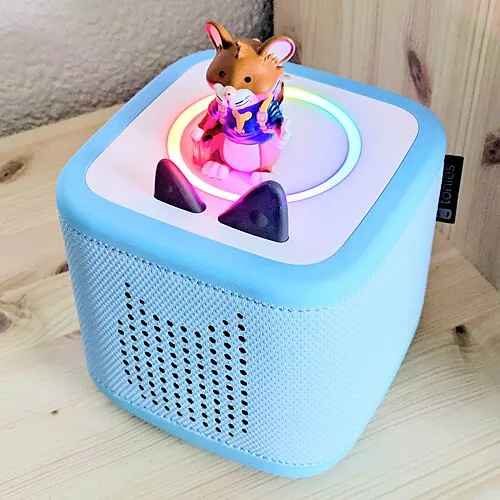
Toniebox 2 Starter Set
Put a character on top and the story starts $149.99Yoto Player (4th Gen)
Card-based audio player for stories, music and podcasts $149.99LittleHippo Mella
The ok-to-wake clock with a face toddlers understand $54.99Screen-free swaps for school-age kids (6–10)
School-age kids want independence and something to show friends. These swaps give them both.
- Photos without a phone: the Camp Snap 2 has no screen, so kids see their shots later.
- Talking to friends: walkie-talkies for the backyard, or a Wi-Fi landline like Tin Can for calling approved contacts.
- Family evenings: a card game like What Do You Meme? Family Edition for kids 8 and up.
When devices do come in, a written family tech agreement keeps everyone on the same page.
Camp Snap 2
The viral screen-free digital camera $69.99Retevis RT628 Kids Walkie-Talkies
A rechargeable 2-pack for backyard missions $21.99Tin Can
The screen-free Wi-Fi landline every school is talking about $100free plan availableWhat if we're over the recommended screen time?
You're not failing. Sick days, long flights and the hour you need to make dinner happen in every family. Pick one small change, like screen-free meals or a story player at bedtime, and build from there.
If you're worried about your child's media use, the AAP suggests talking with your pediatrician.
Frequently asked questions
How much screen time should a 2-year-old have?
The WHO says no more than 1 hour a day of sedentary screen time for 2-year-olds, and less is better. The AAP's 2026 guidance gives no hour limit and focuses on content and watching together.
Is any screen time okay for babies?
The WHO says screen time is not recommended under age 1. The AAP's earlier guidance made an exception for video chatting with family.
Does the AAP still say one hour a day for preschoolers?
No. The AAP's 2026 policy replaced its earlier guidance and doesn't set hour limits. The WHO still recommends no more than 1 hour a day for ages 2–4.
How much screen time should a 7-year-old have?
Neither the WHO nor the AAP gives a number for school-age kids. The WHO says to limit recreational screen time, and the AAP recommends a family media plan and screen-free bedrooms and meals.
What are the 5 Cs of media use?
Child, Content, Calm, Crowding out and Communication. It's an AAP framework for thinking about media use instead of only counting minutes.
Should kids have screens in their bedroom?
AAP family guidance suggests starting screen-free zones with bedrooms and mealtimes, especially in the hour before bed.
Does homework on a computer count as screen time?
The WHO's guidance for ages 5–17 focuses on recreational screen time. The AAP looks at content and context, so schoolwork is a different conversation from entertainment.
Sources
- To grow up healthy, children need to sit less and play more (WHO guidelines for children under 5, 2019), World Health Organization
- Guidelines on physical activity, sedentary behaviour and sleep for children under 5 years of age, World Health Organization
- World Health Organization 2020 guidelines on physical activity and sedentary behaviour, British Journal of Sports Medicine (PMC)
- American Academy of Pediatrics calls for creating a child-friendly digital world (Jan. 20, 2026), AAP
- Creating a child-friendly digital world: AAP releases new media recommendations, HealthyChildren.org
- Helping Kids Thrive in a Digital World: AAP Policy Explained, HealthyChildren.org
- Why to Avoid TV for Infants & Toddlers (2016), HealthyChildren.org
- Family Media Plan, HealthyChildren.org (AAP)
We may earn a commission when you buy through links on this page, at no extra cost to you. It never decides what we list. More
Keep reading
Family Phone Rules Template: A Copyable Tech Agreement (2026)
A free, copyable family phone rules template: where phones sleep, meals, homework, approving apps and contacts, consequences and a review date, by age.
Best-of list · ParentsBest Screen-Free Audio Players for Kids (2026): Yoto vs Toniebox
The best screen-free audio players for kids in 2026: Yoto Player for most homes, Yoto Mini for travel, Toniebox 2 for toddlers. Prices, specs, tradeoffs.
Best-of list · ParentsBest Screen-Free Gifts for Kids by Age (0–12): 2026 Guide
Screen-free gift ideas for kids by age: babies, toddlers, preschoolers, 6–8 and 9–12. Audio players, cameras, walkie-talkies and games, with prices.