How to Get Film Developed in 2026 (Labs, Scans, Half-Frame)
Updated 2026-11-10 · By the Touch Grass editors
Finish the roll, rewind it into its canister, and take it to a local photo lab or mail it to a film lab. Most color film, like Kodak Gold 200, uses the standard C-41 process that almost every lab runs. Ask for "develop and scan" to get digital files plus your negatives back. If you shot half-frame, tell the lab so they scan it correctly.
You finished your first roll. Now what? Getting film developed is easier than it sounds. You hand a roll to a lab, and a few days or weeks later you get your negatives back plus digital scans you can save, print or text to the group chat.
This guide covers the basics: which process your film needs, how to choose a lab, what "scans" actually are, and the one thing half-frame shooters need to tell the lab.
| Option | Good for | Watch out for |
|---|---|---|
| Local photo lab | Talking to a person, faster pickup, no shipping | Not every town has one; scan options vary |
| Mail-in film lab | Wide choice of scan sizes and services, works anywhere | Shipping time and cost, packaging your film safely |
| Big-box or drugstore photo counter | Convenience, if they still accept film | Some send film out, may not offer scans, and may not handle half-frame. Ask first |
What does developing film actually mean?
Developing is the chemical process that turns the invisible image on exposed film into a visible negative. Until it's developed, your roll is a light-sensitive strip, and opening it in daylight ruins it.
After developing, most labs also scan the negatives (turn each frame into a digital file) and can make prints. You can usually choose develop only, develop and scan, or develop and print.
Step 1: Finish and rewind the roll
Shoot until the camera won't advance, then rewind the film fully back into its canister before you open the back. Check your camera's manual for how its rewind works. If you open the back before rewinding, light hits the film and you'll lose some or all of the roll.
If you used a disposable camera, don't open it. Labs develop those by taking the film out of the whole camera.
Step 2: Check which process your film needs
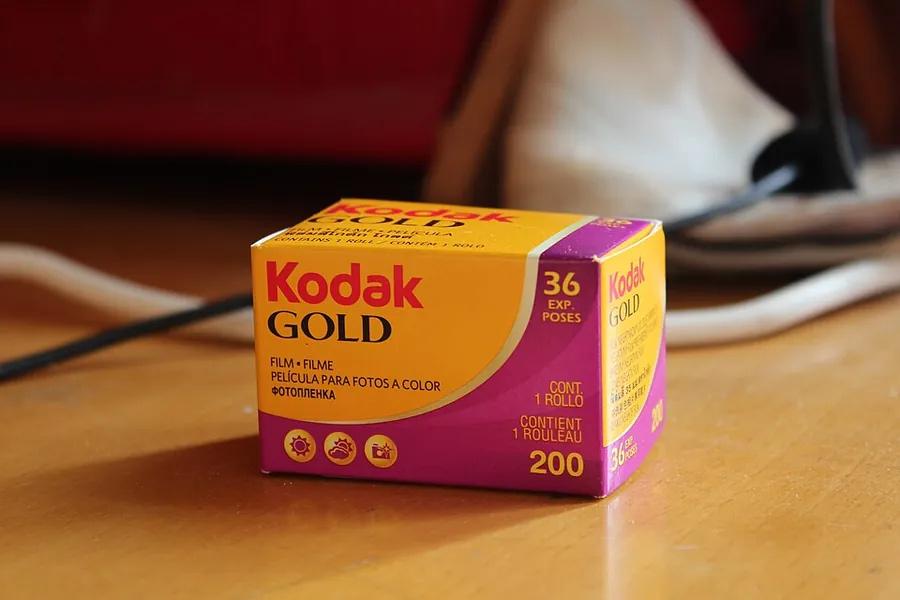
Most color film uses the C-41 process, which almost every lab runs. Check the box or the canister. Color negative films like Kodak Gold 200 are C-41.
C-41 is a standard Kodak introduced in 1972. The film goes through a developer, a bleach, a fixer and a stabilizer, with the developer held at about 100°F. Because the process is standardized, any C-41 lab can handle any brand of color negative film. The result is a negative with an orange tint, which the scanner or printer corrects.
- Color negative film: C-41. The easy one.
- Traditional black-and-white film: a different process, and fewer labs offer it. A few black-and-white films, such as Ilford XP2 Super, are made to run in C-41.
- Slide (reversal) film: also a different process. Fewer labs run it, so check before you send.
Step 3: Choose a local lab or a mail-in lab
Use a local lab if there's a good one near you, and a mail-in lab if there isn't. Both can do excellent work.
A local lab means no shipping, a real person to ask questions, and often a faster turnaround. Search for "film lab" or "photo lab" plus your city, and check recent reviews for comments about scan quality.
A mail-in lab works from anywhere. You order online, ship your rolls, and get a download link for your scans. Many mail-in labs offer several scan sizes. Compare a few on price per roll, scan size, turnaround time and whether they return your negatives.
Some big-box stores and drugstores still take film, but some send it to an outside lab, and services like scanning vary by store. Ask before you drop it off.
Step 4: Pick scans, prints or both
For most people, "develop and scan" is the right order. You get digital files of every frame and your negatives back, and you can print favorites later.
Scans are digital images made from your negatives. Labs usually offer a few sizes. Smaller scans are fine for sharing on a phone, and larger scans keep more detail for big prints or editing. Some labs also offer uncompressed files (often TIFF) on top of standard JPEGs. If you're not sure, the lab's standard or mid-size scan is a safe start.
Prints are nice for an album or the fridge, but you don't need to print the whole roll. Pick the keepers from your scans.
Step 5: If you shot half-frame, tell the lab
Tell the lab your roll is half-frame when you order. Half-frame cameras like the Kodak Ektar H35N fit two vertical photos in the space of one normal frame, so a 36-exposure roll gives you about 72 photos.
Developing is the same; scanning is where it changes. As Parallax Photographic puts it, letting your lab know means they can tell you whether they scan it as 72 single frames or 36 diptychs (two photos side by side in one file). Half-frame scanning policies and prices vary from lab to lab, so ask about both before you send the roll.
Diptychs are not a bad thing. Two photos next to each other can tell a little story, and some people shoot half-frame for exactly that look.
Step 6: Ship your film safely (mail-in labs)
Pack rolls snugly in a padded mailer or small box, include the lab's order form or order number, and use a shipping option with tracking.
- Label each roll if you want them handled differently (for example, one half-frame roll and one regular).
- Keep a note of what's on each roll in case one goes missing.
- Check the lab's site for anything it asks you to include or avoid.
Step 7: Get your scans and keep your negatives
When the lab finishes, you'll get a download link or pickup notice, and your negatives back if you asked for them. Download the scans right away; links can expire.
Keep your negatives in sleeves somewhere cool and dry. They're your originals. If a scan looks off, or you want a bigger file later, you can have the negative rescanned.
Want to start shooting? Our best screen-free cameras guide covers film, digital and instant options.
Frequently asked questions
What does C-41 mean?
C-41 is the standard process for color negative film, introduced by Kodak in 1972. Almost every photo lab runs it, and most color film, including Kodak Gold 200, uses it.
How much does it cost to develop a roll of film?
It depends on the lab, the scan size and whether you add prints. Ask for the price per roll for develop and scan, and ask whether half-frame costs extra.
What are film scans?
Scans are digital image files the lab makes from your developed negatives. You download them and can share, edit or print them like any other photo.
Can any lab develop half-frame film?
Developing is the same as regular 35mm, so any C-41 lab can develop color half-frame film. Scanning varies, so tell the lab it is half-frame and ask whether they scan single frames or pairs.
Should I get my negatives back?
Yes, if the lab offers it. Negatives are your originals and can be rescanned or printed later.
Can I develop film at home?
Yes. Home C-41 kits exist, but temperature control matters, since the developer runs at about 100°F. Most beginners start with a lab.
What if I opened the camera before rewinding?
Light probably reached part of the roll. Get it developed anyway; frames that were wound inside the canister may survive.
Sources
We may earn a commission when you buy through links on this page, at no extra cost to you. It never decides what we list. More
Keep reading
Best Screen-Free Cameras of 2026: Digital, Film and Instant
The best screen-free cameras of 2026, from the Camp Snap 2 to half-frame film and instant cameras, with prices, cost per photo and who each one is for.
ExplainerWhy Is Gen Z Buying Digicams? The Point-and-Shoot Comeback
Why Gen Z is buying digicams: the early-2000s flash look, less-processed photos, shooting with intention, and new cameras like the Kodak Charmera.
Best-of listBest Analog Gifts Under $50 (Screen-Free Ideas for 2026)
The best analog gifts under $50 for 2026: Kodak Charmera, Tamagotchi Paradise, Hobonichi Techo, Casio F-91W and more screen-free ideas for all ages.